
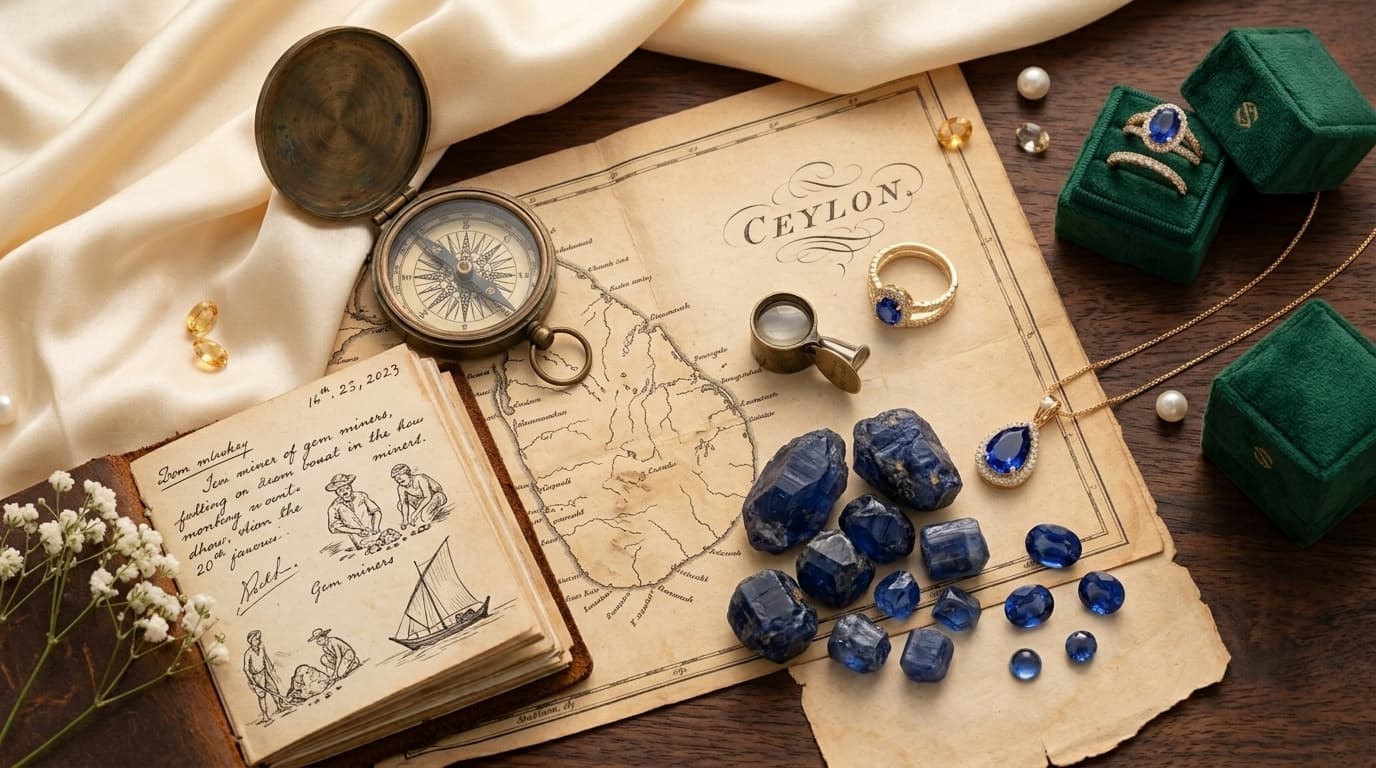
Long before it was called Sri Lanka, this island was known to travellers as a place where the earth simply gave up its treasures. Here is why.
Sail into any old atlas of the Indian Ocean and you will find this small island marked not by its shape but by its reputation. Arab traders called it Serendib. Greek and Roman writers spoke of Taprobane in tones usually reserved for myth. And for well over two thousand years, one description has followed the island more than any other: the Gem Island.
It is not an exaggeration dreamed up by a modern tourism board. Sri Lanka earned the title the hard way, through millennia of gem-bearing gravel, patient miners, and a trade network that carried its stones from village pits to the courts of emperors. Few nations anywhere can claim a nickname this durable, one that has survived changes of language, religion, and government while still describing exactly what the country does best.
A Concentration of Gems Found Almost Nowhere Else
What makes Sri Lanka unusual is not simply that it produces gemstones, many countries do that, but how many different kinds of fine gemstones come out of such a compact landmass. Sapphires, rubies, alexandrite, spinel, garnet, zircon, tourmaline, moonstone, and chrysoberyl cat's-eye have all been recovered from the island's gem gravels, known locally as illam.
Geologists studying the region have long remarked that few places on earth pack this much gemological diversity into so small an area. That density of riches, sitting close to the surface in ancient river gravels, is precisely why gem pits have been worked here since antiquity rather than abandoned as curiosities.
Compare that to most of the world's other major gem-producing regions, which tend to specialise in one or two dominant stones, and the scale of Sri Lanka's variety becomes clearer. A single afternoon's washing of gravel near Ratnapura can, in principle, turn up sapphire, garnet, and spinel from the very same pit, a kind of geological generosity that few other places can match.
A Reputation Built Over Two Thousand Years
Historical accounts describe Sri Lankan gems reaching Rome, Persia, and China along early maritime trade routes. Marco Polo, writing in the thirteenth century, described the island's king possessing a ruby so magnificent that Kublai Khan himself tried to acquire it. Arab geographers wrote of a river that carried rubies down from the island's hills after the monsoon rains.
Centuries later, colonial Portuguese, Dutch, and British administrations all took a direct interest in the gem pits of the interior, each recognising what local miners had known all along: this was a landscape where fortune could genuinely be dug out of the ground. Written records from these colonial periods describe organised gem taxes and licensing systems, evidence of just how central the trade already was to the island's economy long before anyone thought to call it an industry.
Why the Name Still Fits Today
Modern Sri Lanka has not simply coasted on old legends. The country remains one of the world's most important sources of fine sapphire, and Ceylon sapphires in particular are prized by jewellers and collectors for their exceptional clarity and colour. Ratnapura, whose name literally translates to City of Gems, still anchors a living industry of miners, cutters, and dealers who carry forward techniques passed down through generations.
That living industry today includes formal licensing, gemological laboratories, and export standards that did not exist in the era of Marco Polo, yet the fundamental activity, patient hands searching gravel for a flash of colour, has barely changed. It is this continuity, ancient reputation matched by present-day output, that keeps the title so firmly attached to the island.
So when someone asks why Sri Lanka is called the Gem Island, the honest answer is that no other name has ever fit better. It is a title earned in gravel pits and river beds, carried across oceans by traders, and still being written today, one stone at a time.